
Getting Started with QuantSentry v2
How the v2 Risk Cockpit shell is organized, how it maps to v1's detection layers, and where to find each page.
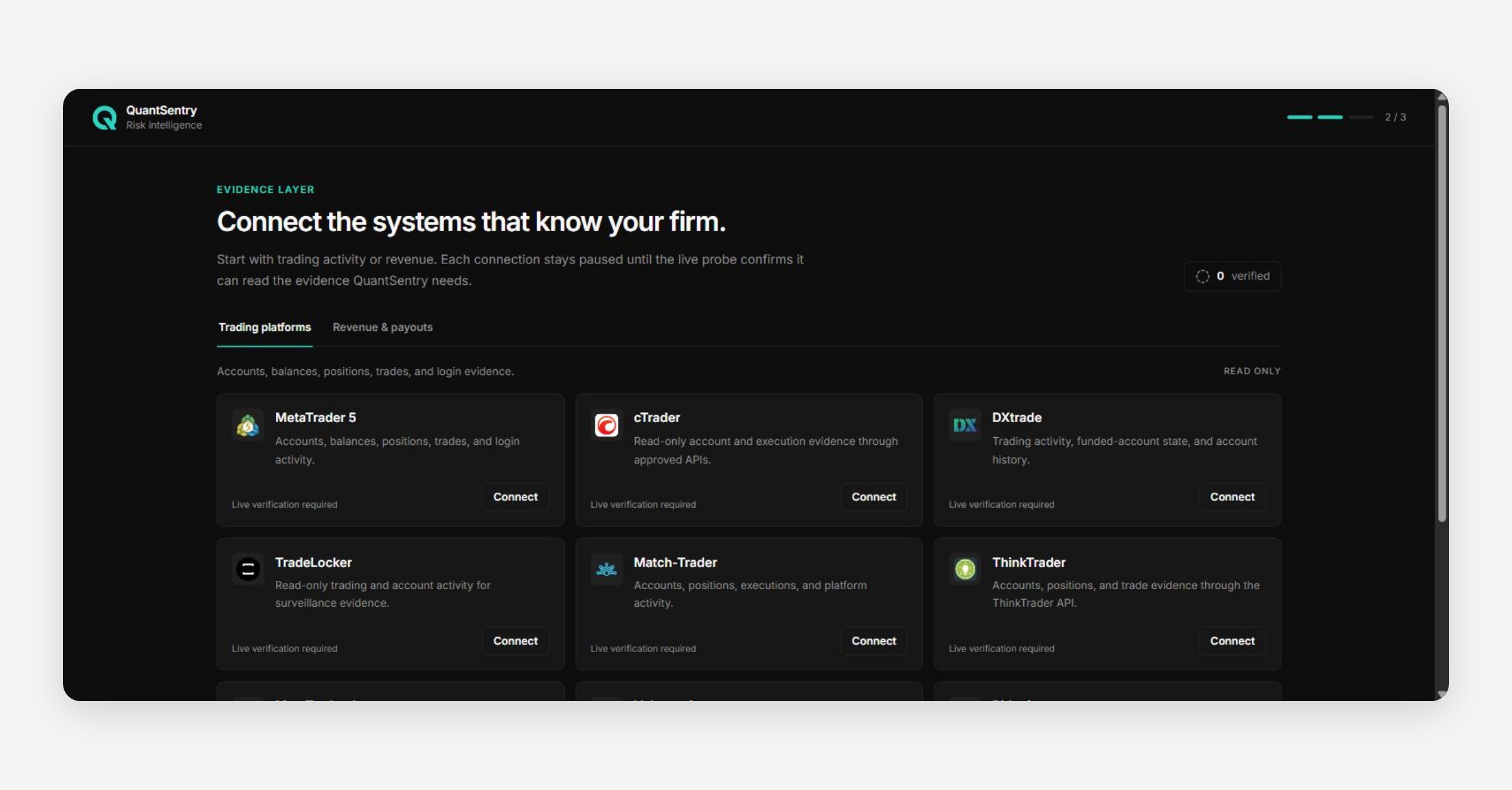
Getting Started with QuantSentry v2

QuantSentry v2 (the Risk Cockpit) is the operator-facing layer on top of QuantSentry's vector-based detection engine. Where the v1 platform surfaced fraud detection through a matching-engine-first workflow (trade pairs → alerts → investigation), v2 reorganizes the same underlying evidence around the questions a firm actually asks day to day: how is the business doing, who needs a human before money leaves, and what's connected to what.
The detection math hasn't changed — copy trading, hedge rings, account fleets, martingale abuse, and organized group fraud are still caught the same way. What changed is the shell: v2 gives every role (owner, risk manager, finance) a home screen suited to their job, plus Argus, a conversational AI coworker that can answer questions about the data directly instead of requiring you to build a report.
The Shell
The left sidebar is grouped into four sections, plus Settings:
Group | Pages | What it answers |
|---|---|---|
Overview | Desk, Firm, Data analysis, Targets | How is the business doing right now, and against plan? |
Analytics | Traders, Products, Insights | Who are our customers, what do they buy, and how do we compare to the market? |
Finance | Orders, Payouts | What money came in, and what money is going out? |
Risk | Cases, Relationships | What needs a human decision, and who is connected to whom? |
Settings | Connections, Members, Metrics, Targets, Detection, Account sizes, Programs, API keys, MCP, Slack | How is the workspace configured? |
Every page respects the same date-range switcher (Today / 7D / 30D / 90D / MTD / QTD / YTD / All / Custom) and compares the selected window against the prior comparable period.
Argus
A floating button in the bottom-right corner of every page opens Argus, described in-product as "your risk coworker." Argus can read revenue, payouts, cases, and evidence, and will show its reasoning steps (e.g. "Checked Open payouts," "Checked Paid payouts") before answering. It is explicitly scoped: it does not approve or deny payouts, suspend accounts, or take any money-affecting action — it observes and explains, a human still decides.
See the Argus article for how to configure and use it.
How v2 Relates to v1's Detection Layers
If you're coming from v1, here's the mapping:
v1 concept | v2 equivalent |
|---|---|
Alerts (matching engine output) | Cases — the same detector evidence, reframed as "needs your attention" work items with a recommendation (Monitor / Investigate now) and a triage status |
Traders view / network heat map | Relationships — cross-trader connections by evidence type (trading behaviour, login), with observation counts and last-seen timestamps |
Account/Trader investigation pages | Traders — a "Passport" per trader combining Identity/KYC, Financial integrity, and Trading behaviour in one read-only profile |
Home Dashboard (risk trend, geo map) | Desk and Firm — business-pace framing (revenue, payouts, targets) rather than a pure risk trend; deep risk investigation now lives in Cases and Relationships |
Detection Rules Overview / Settings | Settings → Detection |
Scoring Weight Settings | Settings → Metrics |
Quick Navigation
Page | What you'll find |
|---|---|
Desk | Revenue, pending payouts, paid out, and a "Do these now" worklist |
Firm | Revenue vs. payouts flow and the firm's health score |
Data Analysis | Build-your-own chart over any business measure, shareable by URL |
Targets | Progress toward revenue, profit, and payout-ratio targets |
Traders | Every trader the firm has seen, with money and account evidence in one place |
Products | Revenue concentration and customer progression by product |
Propfirm Insights | Competitive intelligence on market pricing, splits, and rule trends |
Orders | Every order the firm has taken, settled or not |
Payouts | Every payout the firm has handled, settled or not |
Cases | Trader-lifetime cases built from detector evidence, with a recommendation and triage status |
Relationships | Who is connected to whom, by evidence method |
Settings | Connections, members, detection tuning, targets, and developer access |
Argus | The AI assistant available on every pag |
Was this helpful?